
Topic:
Property & Casualty
Article content

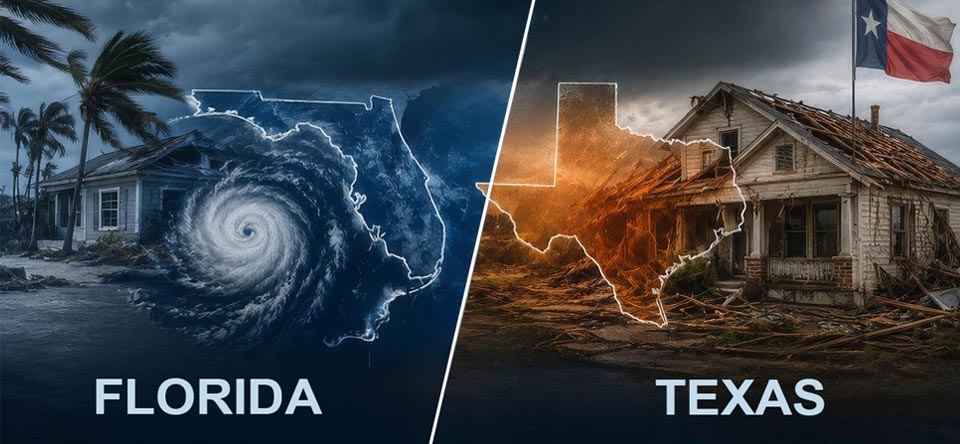
When a hurricane tears through a community the damage you can see is only part of the full story. Behind all the broken windows and glass, and soaked carpets are the families trying to figure out where they’re going sleep, how they will cope, and what comes next fort hem. Florida and Texas have both weathered some of the most destructive storms in American history, and the people who live there know that recovery is rarely a simple process. One of the most stressful parts of that recovery is dealing with an insurance claim, and the rules are not the same in both states.
It is easy to think of a hurricane claim as a transaction, like a matter of numbers and paperwork. For the people living through it though, it feels absolutely nothing like that. After a major storm a homeowner might be staring at a collapsed roof, walking across floors that squish under their feet, or come home to find a tree resting where the living room used to be! Power can stay out for days or even weeks. Children are out of school and work is often disrupted. Sleep is also hard to come by.
Insurance companies understand that this is an exhausting, disorienting time, and that understanding does not always work in the homeowner's favor. When people are tired and desperate to start rebuilding they often tend to accept whatever offer arrives first. This is just to move forward with things. That instinct is completely human and understandable, but it can be costly. The first offer a homeowner receives is rarely the one that reflects the full extent of the loss and damage.
Both states expect insurers to treat policy holders fairly and to act in good faith. Beyond that shared principle, the landscape changes.
In Florida, the sheer frequency of hurricanes has shaped a body of insurance law that tends to be demanding on insurers. Companies are generally expected to acknowledge claims promptly andto keep policyholders informed as the process moves along. At the same time, Florida's insurance market has been turbulent for years. Some insurers have left the state, others have struggled financially, and policy language can bedense and open to interpretation. That ambiguity sometimes becomes a tool for reducing what a homeowner ultimately receives.
In Texas, much of the framework comes from the Prompt Payment of Claims Act, which establishes deadlines for insurers to investigate and pay valid claims. The penalties for missing those deadline scan be significant, which gives the law real force. After a large storm the insurers sometimes argue that the volume of claims makes ordinary timelines impractical. That argument creates potential gray areas and the homeowners are often left trying to figure out where they stand with things.
No matter which state you live in, having a well-documented claim makes for a stronger claim. The more clearly a homeowner can show what was damaged and then what it will cost to repair, the harder it becomes for an insurer to minimize their loss.
Photographs and video of the damage matter a great deal, such as covering the roof, the interior, the exterior, and also the personal belongings. So does having receipts and estimates for things like temporary repairs and fixes, emergency services, and the cost of staying somewhere else while the home is unlivable for them. This kind of evidence becomes especially important if a dispute arises later about how bad the damage really was, or, when it happened.
When thousands of claims land on an insurer's desk at the same time, certain patterns tend to appear. Initial estimates may come in low and investigations may stretch on with little explanation at all. Homeowners may be asked for documentation that seems excessive or repetitive. In some cases, the damage that was caused by the storm may end up being labeled as something that existed even beforehand.
None of this is necessarily a sign of bad intent in every case, but the cumulative effect of it can be the same. Leading to lower payouts and homeowners that feel way too worn down to argue on things. Recognizing these patterns is the first step toward responding to them effectively.
There comes a point in some claims where a homeowner realizes they are not being heard. Calls can go unreturned, and offers stay low. The gap between what the insurer says and what repairs actually cost seems to keep on growing. That is often the moment to consider professional legal guidance.
An attorney who handles property damage claims understands the laws specific to each state, knows how insurers tend to operate after a catastrophe, and can advocate for fair treatment when a homeowner/property owner is being overlooked or underpaid. Having someone in your corner can change the entire tone and outcome of a claim.
Families in Florida and Texas deserve full and timely compensation after a hurricane. With the right information and the right support, the claims process becomes far less intimidating, and rebuilding becomes something you can do on your own terms.
If you are dealing with a hurricane insurance claim and feel like you are not getting fair treatment, the team at Finman Law Group is here to listen. Reach out today for a conversation about your situation and learn how we can help you pursue the compensation you‘re owed.





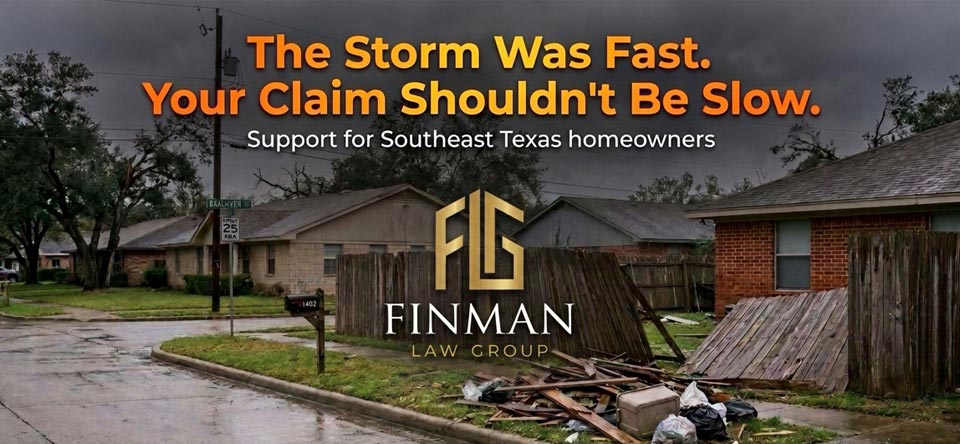
Storm Edouard left roof leaks, broken windows, and water damage across Southeast Texas. Finman Law Group helps homeowners with delayed or underpaid claims.

Upstairs neighbor water damage creates messy condo and apartment claims. Learn what residents typically do and how Finman Law Group can help. Free evaluation.
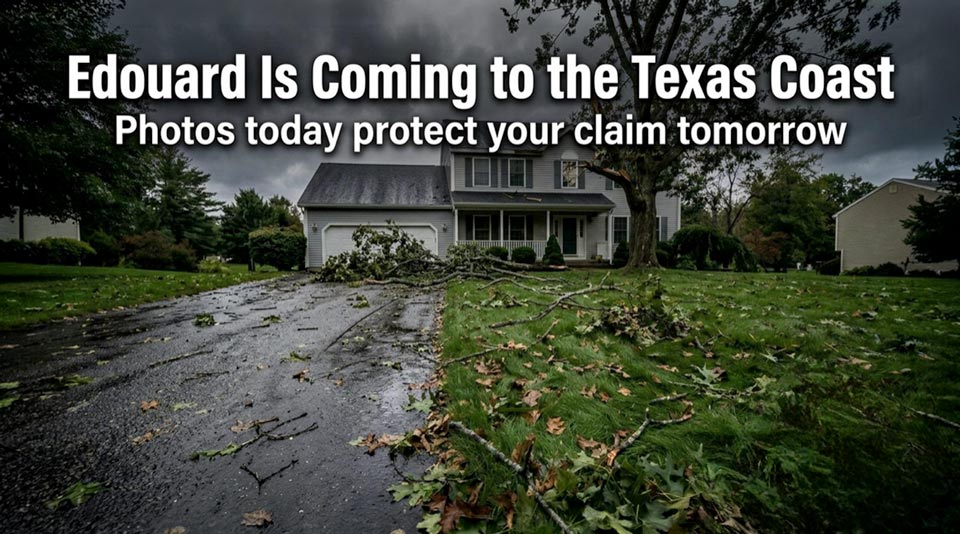
Tropical Storm Edouard is approaching the upper Texas coast. Learn what property owners in Houston, Galveston, and Southeast Texas can expect and how to prepare.